
It’s not just you.
Your phone buzzes.
Your watch taps your wrist.
A banner slides across your screen.
And instead of feeling informed, you feel… on edge.
Somewhere along the way, notifications stopped being helpful reminders and started feeling like constant interruptions. And this week, more people are quietly coming to realize it.
Notifications Were Supposed to Help Us
The original idea was simple.
Notifications existed to:
- Alert you to something important.
- Save you from checking your phone constantly.
- Help you respond faster when it mattered.
A message.
A reminder.
An emergency alert.
That was it.
But the way notifications work today is very different.
Everything Wants Your Attention Now
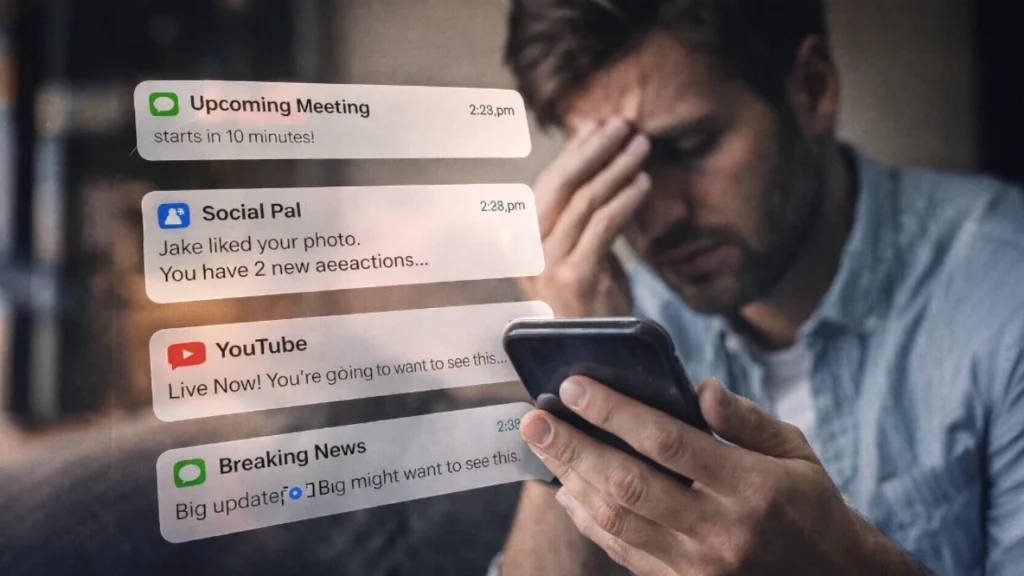
The average phone now sends dozens of notifications a day — and most of them aren’t urgent.
You get alerts for:
- Likes and reactions
- “You might like this” suggestion.
- App updates
- Daily summaries
- Content you didn’t ask for
Every app wants to be “top of mind.”
The result?
Your brain stops treating notifications as signals and starts treating them as noise.
Why Notifications Create Stress (Even When You Ignore Them)
Here’s the part people don’t talk about much.
Even when you don’t open a notification, your brain still reacts.
Each buzz creates:
- A micro-interruption
- A split-second decision (“Do I check this now or later?”)
- A sense of unfinished business
That tiny mental load adds up fast.
By the end of the day, it feels like you’ve been mentally pinged nonstop, even if you ignored most of it.
The “Everything Is Important” Problem
When every notification is marked urgent, nothing feels truly important anymore.
A delivery update gets the same alert style as:
- A work message
- A security warning
- A family text
Your phone doesn’t know context.
Your brain does — but it has to work overtime to sort it out.
That constant prioritization drains focus.
Why This Feels Worse Than It Used To
A few things changed quietly over the years:
1. Notifications Became Smarter — and Louder
Apps learned when you’re most likely to tap.
So alerts arrive at the worst possible times.
2. Devices Multiplied
Phone. Watch. Laptop. Tablet.
The same alert follows you everywhere.
3. Opt-Out Replaced Opt-In
Many apps now turn notifications on by default.
You’re expected to turn them off manually.
Most people never do.
Notification Fatigue Is Real
There’s a reason people:
- Swipe alerts away instantly.
- Keep their phones on silent.
- Feel anxious when their phone buzzes.
It’s not a distraction.
It’s overexposure.
Your brain treats constant alerts like low-grade stress. Not enough to trigger panic — just enough to wear you down.
Why You Still Don’t Turn Them All Off
If notifications are so stressful, why don’t people just disable them?
Because notifications also bring:
- Social connection
- Timely info
- A sense of control
Turning everything off feels risky.
What if you miss something important?
What if someone needs you?
So people stay stuck in the middle — overwhelmed but afraid to disconnect.
The Quiet Shift Happening Now
Here’s why this topic is trending right now.
More people are:
- Customizing notification summaries
- Using focus modes more intentionally
- Turning off non-essential alerts
- Letting their phones stay silent longer
Not because of a productivity trend — but because stress tolerance is lower.
People don’t want less technology.
They want less friction.
What Actually Helps (Without Going Extreme)
You don’t need a digital detox.
Small changes work better:
- Keep alerts only for people, not platforms.
- Turn off notifications that don’t require action.
- Batch alerts instead of receiving them instantly
- Let silence be the default.
The goal isn’t to miss less.
It’s to interrupt less.
The Real Issue Isn’t Notifications
Notifications aren’t the enemy.
The real issue is that they’ve turned into constant negotiations for your attention.
And attention, right now, feels more valuable than ever.
That’s why notifications don’t feel helpful anymore.
They feel exhausting.
Final Thought
Tech didn’t suddenly become stressful.
It became persistent.
And when everything asks for your attention, your nervous system quietly pushes back.
That’s not failure.
That’s adaptation.