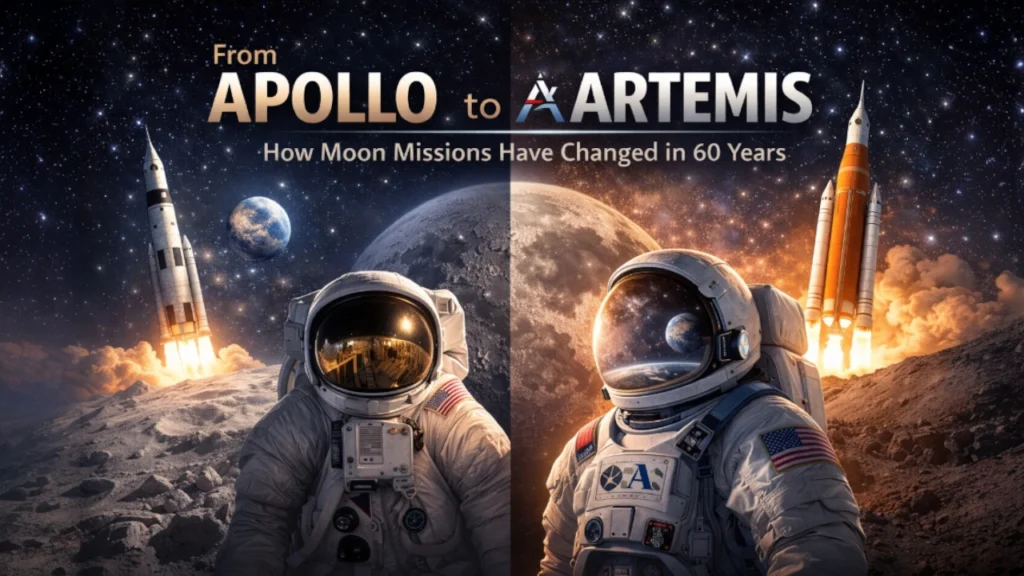
Sixty years ago, going to the Moon felt like a dare.
Today, it feels like a decision.
That difference says everything about how far human spaceflight has come.
When the Apollo astronauts climbed into their capsules, nobody truly knew how the mission would end. When Artemis astronauts prepare for lunar missions now, uncertainty still exists—but it’s measured, modeled, and deeply studied.
The Moon hasn’t changed.
We have.
When Apollo Went to the Moon, the Goal Was Simple: Get There Alive
Apollo-era Moon missions were born out of a sense of urgency.
The Cold War was raging. The deadline was political. Failure wasn’t just scientific—it was symbolic.
Apollo missions focused on:
- Proving humans could reach the Moon
- Planting a flag
- Returning safely, if possible
Technology was raw by today’s standards. The onboard computers were weaker than what you’d find in a basic handheld calculator today. Navigation relied heavily on human judgment. Astronauts memorized procedures because there was little margin for error.
Every launch felt like a leap into the unknown.
There was bravery, but also a kind of accepted risk that would be unthinkable today.
Artemis Isn’t Racing Anyone. It’s Building Something.
The Artemis era is defined by patience.
Instead of a single historic moment, the goal is long-term presence.
Instead of beating a rival, the focus is on sustainability.
Artemis missions are designed to:
- Establish repeatable lunar travel.
- Support long-duration exploration
- Prepare humans for Mars.
This shift changes everything—from spacecraft design to astronaut training.
Apollo asked: Can humans survive on the Moon?
Artemis asks: Can humans live beyond Earth?
The Technology Gap Feels Like Science Fiction

Apollo technology was revolutionary for its time. Artemis technology is adaptive by design.
Then (Apollo):
- Minimal onboard computing
- Limited communication bandwidth
- Manual navigation and course correction
- No real-time health analytics
Now (Artemis):
- Autonomous flight systems
- Advanced life-support monitoring
- Radiation protection strategies
- Real-time biomedical feedback
Apollo relied heavily on astronaut instinct. Artemis blends human judgment with machine intelligence.
This isn’t about replacing astronauts—it’s about supporting them when Earth is far away.
The Astronaut Experience Has Changed Dramatically
Apollo astronauts were test pilots first, scientists second.
Artemis astronauts are a blend of:
- Engineers
- Scientists
- Medical specialists
- Deep-space decision-makers
Training now includes:
- Long-duration isolation simulations
- Psychological resilience preparation
- Communication-delay drills
- Team conflict management
Modern lunar missions recognize something Apollo missions learned the hard way: space tests the mind as much as the body.
If you’re curious about how that mental preparation works today, this deep dive into astronaut psychology explains it beautifully:
👉 Inside the Artemis II Crew’s Minds: What Astronauts Are Preparing for the First Lunar Flight in Decades
Mission Risk: From Acceptance to Prevention
Apollo-era missions accepted high risk as part of the deal.
Artemis missions are built around risk reduction.
Not because astronauts are less brave—but because lives are too valuable to gamble casually.
Today’s missions involve:
- Years of uncrewed testing
- Redundant safety systems
- Abort scenarios modeled in advance
- Incremental progress instead of giant leaps
Failure is no longer heroic.
Preparation is.
Communication Has Gone From Delayed to Strategic
Apollo astronauts spoke to Earth with crackly audio and limited data. When communication failed, astronauts figured things out alone.
Artemis missions are designed around intentional communication delay.
Why? Because future Mars missions won’t have instant feedback. Crews must learn to:
- Make independent decisions
- Trust onboard data
- Resolve issues without real-time Earth support.
The Moon is no longer just a destination—it’s a classroom.
Why Artemis Isn’t “Just Apollo With Better Tech”
This comparison often misses the point.
Apollo answered one question.
Artemis is answering dozens.
Apollo was about to arrive.
Artemis is about endurance.
Apollo proved what humans could do once.
Artemis is proving what humans can do repeatedly.
That difference matters if space exploration is going to last beyond headlines.
The Quiet Shift Most People Miss
The most important change isn’t hardware.
It’s a mindset.
Apollo astronauts carried the hopes of a nation.
Artemis astronauts carry the responsibility of the future.
Their missions aren’t measured only by success, but by sustainability.
Can humans operate calmly when Earth is distant?
Can teams function under isolation and silence?
Can exploration continue without rushing the clock?
Those are modern questions.
What the Moon Means Now
In the Apollo era, the Moon was a finish line.
In the Artemis era, it’s a beginning.
A testing ground.
A proving space.
A reminder that progress doesn’t have to be reckless to be revolutionary.
Final Thought
Looking back, Apollo feels bold and audacious.
Looking forward, Artemis feels deliberate and thoughtful.
Both are powerful in their own way.
One taught us how to reach the Moon.
The other is teaching us how to stay curious—and human—far from home.
And maybe that’s the real evolution of spaceflight. 🌙🚀