
AI browsers are having a moment.
Every week, there’s a new announcement. Smarter tabs. Instant summaries. Built-in assistants that promise to “change how we use the internet.”
On paper, it sounds inevitable. Even exciting.
In reality, I’m not convinced most people need one — or will enjoy using one long-term.
Not because the tech is bad.
But because the problem AI browsers claim to solve… isn’t the problem most users actually have.
Let’s slow down and talk about that.
What AI browsers promise to fix
The pitch is usually some version of this:
- You open fewer tabs
- You find answers faster.
- You don’t need to think as much while browsing.
AI watches how you navigate, summarizes pages, suggests actions, and sometimes even decides what you should read next.
In theory, this should reduce friction.
In practice, it introduces a new one.
Browsing isn’t the bottleneck people think it is
Most users don’t struggle because browsers are “too dumb.”
They struggle because:
- There’s too much content.
- Too many notifications
- Too many decisions are happening at once
An AI layer doesn’t remove that overload.
It repackages it, often with less transparency.
Instead of choosing what to click, you’re now choosing whether to trust what the AI picked for you.
That’s not simplification.
That’s delegation — and delegation comes with trade-offs.
The hidden cost: losing intent
Traditional browsing is intentional.
You type something.
You skim.
You decide what matters.
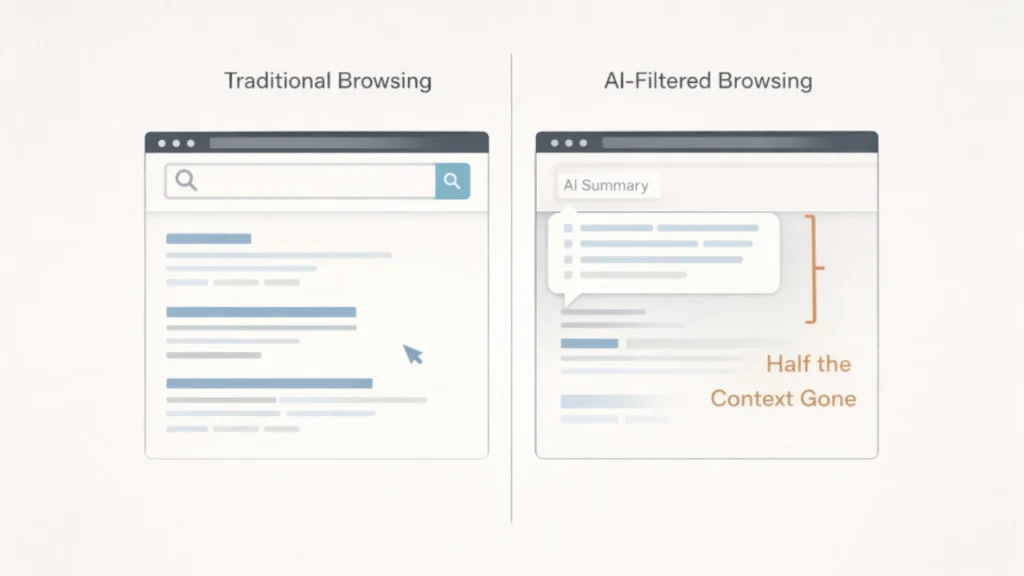
AI browsers shift that flow.
They summarize before you decide.
Speed isn’t the same as understanding — and AI browsers often trade one for the other.
They highlight what they think is important.
They optimize for speed, not understanding.
That’s fine for quick facts.
It’s not great for nuance.
If you research products, finances, health, or long-term decisions, summaries can flatten context in ways you don’t immediately notice.
You feel informed faster — but not necessarily better.
Privacy becomes… fuzzy.
Most AI browsers need context to work well.
That means:
- Your browsing behavior
- Your tabs
- Sometimes your inputs and preferences
Even when companies promise anonymization, the model still needs data to improve.
For users who already feel uneasy about how much the internet knows about them, AI browsers often cross an invisible comfort line.
The experience feels helpful — until it feels watchful.
And once that feeling kicks in, it’s hard to ignore.
Speed is overrated when it interrupts thinking
There’s a growing assumption in tech that faster is always better.
But some tasks benefit from friction.
Reading reviews.
Comparing options.
Learning something new.
When an AI browser jumps in too early — summarizing, recommending, nudging — it can interrupt your own reasoning.
You save time, yes.
You also outsource part of your judgment.
For a lot of users, that trade isn’t worth it.
Who AI browsers actually make sense for
Despite all this, AI browsers aren’t useless. They’re just mis-marketed.
They work best for:
- Repetitive research tasks
- High-volume reading (emails, reports, docs)
- Users who already trust automation
- People who value speed over depth
They are less ideal for:
- Careful decision-making
- Privacy-conscious users
- Anyone who enjoys reading and exploring on their own
- Users who already feel digitally overwhelmed
If you’re in the second group, the novelty wears off fast.
The bigger problem isn’t browsing — it’s attention
AI browsers treat browsing as the issue.
But the real problem is attention fragmentation.
An AI summary doesn’t fix:
- Endless feeds
- Constant interruptions
- Decision fatigue
It just processes noise faster.
Sometimes the better solution isn’t a smarter browser.
It’s fewer tabs.
Clearer intent.
And knowing when to stop scrolling.
My takeaway
AI browsers aren’t a breakthrough for everyone — and they don’t need to be.
They’re tools.
Powerful ones.
But only useful when they align with how you think.
If you like control, context, and slow understanding, a traditional browser with good habits will feel better long-term.
If you value automation and speed above all else, AI browsers will feel magical.
Just don’t confuse new with necessary.
That’s a mistake the tech world makes often — and users pay for it later.