Climate change isn’t just a future threat — it’s unfolding right now, especially in the coldest corners of Earth. A groundbreaking scientific study shows that entire ecosystems in Antarctica are already shifting, with one of the most iconic species on the planet — penguins — acting as a sensitive barometer for change.
Recent research shows that Antarctic penguins are dramatically altering their breeding season in response to warming temperatures — a change happening faster than scientists ever predicted. These shifts reveal how climate change is disrupting not just weather patterns, but the very timing of life cycles in nature.
Penguins as a Climate Indicator
Penguins aren’t just cute Antarctic residents — they’re also biological indicators of ecosystem health. In a study led by researchers from the University of Oxford and Oxford Brookes University, scientists analysed ten years of data from 77 time-lapse cameras across 37 colonies, tracking breeding behaviour from 2012 to 2022.
The results were startling:
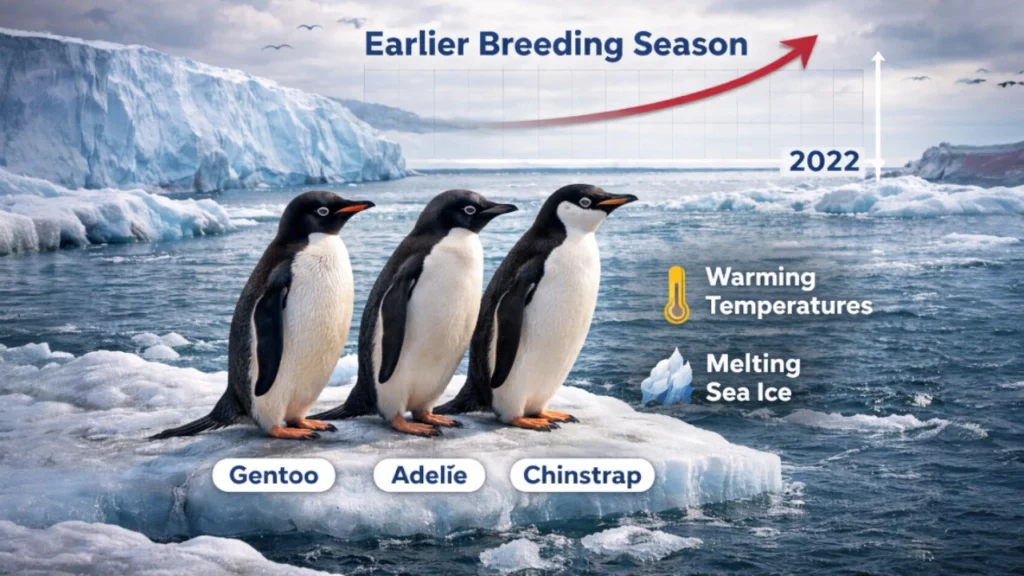
- Gentoo penguins advanced their breeding by up to 24 days in some colonies.
- Adélie and chinstrap penguins also shifted their breeding by about 10 days earlier on average.
- This represents the fastest shift in breeding timing recorded for any bird — and possibly any vertebrate species.
This rapid change is a direct reflection of warming in Antarctic regions, which are heating at rates much faster than the global average. The Antarctic Peninsula, in particular, has warmed up remarkably in recent years, driving changes in sea-ice patterns, food availability, and habitat conditions.
Why Earlier Breeding Matters
Penguins emerged from evolutionary histories perfected for extreme cold and precise seasonal cycles. Their breeding season — when adults mate, lay eggs, and raise chicks — is carefully timed to match peak food availability, particularly krill and other ocean resources that sustain their young.
But as temperatures rise, the timing of environmental cues is shifting:
- Earlier ice melt opens nesting sites sooner.
- Phytoplankton — the base of the food chain — begin blooming earlier.
- Sea-ice dependent food resources like krill may not be abundant when needed by chicks.
This mismatch can spell trouble. If chicks hatch before food is plentiful, their survival rates drop — and this could destabilise populations over time.
Winners and Losers in a Warming World
Not all penguins are responding to climate change the same way:
🐾 Gentoo Penguins
- Generalist feeders — hunt not just krill, but fish and other prey.
- Better able to adapt their diets and respond to changing conditions.
- Their earlier breeding and diet flexibility may give them a short-term advantage.
❄️ Adélie and Chinstrap Penguins
- Specialist krill feeders and historically timed breeders.
- Their earlier breeding doesn’t align well with prey peaks.
- Populations are declining as sea ice shrinks and competition increases from gentoos.
This kind of “winners and losers” dynamic is a hallmark of climate disruption. Species best suited to change may temporarily increase, while specialists struggle to survive.
Phenology: Changing Timing Across Nature
Ecologists use the term phenology to describe the timing of life cycle events — like migrations, flowering, or breeding — and how they’re triggered by environmental conditions.
The changes observed in Antarctic penguins represent a record shift in phenology, happening at a faster rate than any other vertebrate species documented so far.
This isn’t just a local anomaly. Phenological changes are now being documented globally — from plants flowering earlier to migratory birds arriving sooner — all tied to climate change impacts. These shifts can ripple through ecosystems, affecting food chains, predator–prey relationships, and species survival.
Broader Impacts of Climate Change
Climate change influences penguins because it’s a symptom of a much larger global transformation:
- Melting ice: Warmer temperatures reduce sea ice, shrinking habitat, and increasing exposure of species.
- Food web disruptions: Changes in ocean temperatures affect plankton — the foundation of marine food chains.
- Ecosystem imbalance: When species’ life cycles get out of sync, entire ecosystems (like Antarctica’s) risk collapse.
Penguins play a key role in Antarctic food webs by transporting nutrients between the ocean and land — so their decline could have cascading effects across species and the functioning of the entire ecosystem.
What This Tells Us About Climate Change
The rapid shift in penguin breeding seasons is a clear signal of human-driven climate change:
- Long-term temperature increases are altering biological timing.
- Ecological responses are no longer gradual — they’re happening within human lifetimes.
- Even these cold-adapted animals are feeling the heat.
Antarctic penguins, once symbolic of untouched wilderness, are becoming living evidence of a warming planet — and their struggles are a warning that climate impacts are disrupting life in even the most remote places on Earth.
What Must Be Done
Scientists warn that continued warming could further imperil penguins. Key actions include:
- Global emissions reductions
- Protecting marine food webs and habitats
- Long-term monitoring of wildlife and ice conditions
Penguins may be early bellwethers, but their fate is tied to broader climate systems that support biodiversity worldwide.
Final Takeaway
Climate change isn’t a distant future — it’s happening now, and Antarctic penguins are among its most vivid victims and earliest responders. Their shifting breeding cycles are not just biological curiosities; they’re early warning lights for ecological disruption across the planet.
Understanding these changes isn’t just about penguins — it’s about recognising how a warming world is reshaping life on Earth.
Frequently Asked Questions
Why are Antarctic penguins breeding earlier?
Rising temperatures and earlier ice melt are altering environmental cues, prompting penguins to begin breeding sooner than in past decades.
Which penguin species are most affected by climate change?
Gentoo, Adélie, and chinstrap penguins are showing noticeable changes, with gentoo penguins adapting more quickly than the others.
Why does this matter beyond Antarctica?
Penguins are key indicators of ecosystem health. Changes in their behaviour signal broader disruptions in marine food webs and global climate systems.
Are penguins adapting successfully to climate change?
Some species appear to be adapting, but scientists warn this may come at a cost, including reduced chick survival and long-term population risks.