

Millions of people walk up escalators every single day — in airports, metro stations, malls, and office buildings — convinced that it saves time. It feels efficient, even productive.
But engineers, transit authorities, and safety researchers increasingly say that habit may be riskier, less efficient, and more harmful than most people realize.
From accident data to crowd-flow experiments in major cities, new insights suggest that standing still on escalators can actually move more people safely — and walking might be doing the opposite of what we think.
So why do experts discourage walking on escalators, and why do so many people still do it anyway?
The Old Rule: “Walk Left, Stand Right”
In many cities — especially Western ones — you’ll see this etiquette:
- Stand on the right side.
- Walk on the left if you’re in a hurry.
This idea became widespread in places like the London Underground decades ago and carried over to many transit systems.
But increasing safety research and transit trials suggest that even this practice may not be the best approach.
1. Escalators Are Designed for Standing, Not Walking
Manufacturers and escalator safety guides increasingly emphasize that escalators are engineered to move passengers safely when they stand still and face forward. Walking on them:
- increases the risk of slips and falls
- disrupts balance, especially with bags or uneven shoes
- creates hazards for others nearby
— because escalator steps are deeper, taller, and not like regular stairs.
In Tokyo and other parts of Japan, where escalators are heavily used each day, railway operators have launched campaigns urging passengers to stand still and skip walking altogether, partly because of these risks.
2. Walking Increases the Risk of Accidents
According to safety research, a significant number of escalator accidents involve people walking or misstepping rather than standing securely:
- Trip hazards from uneven step heights
- Loose clothing or footwear getting caught.
- Collisions during busy periods
In one Japanese survey, nearly half of recorded escalator accidents were linked to improper behaviour like walking or failing to hold the handrail.
Older adults and people with young children are especially at risk — and safety authorities in Singapore and other cities warn that inappropriate escalator use (like carrying strollers or walking) contributes to the majority of reported incidents.
3. Standing Still Can Be More Efficient
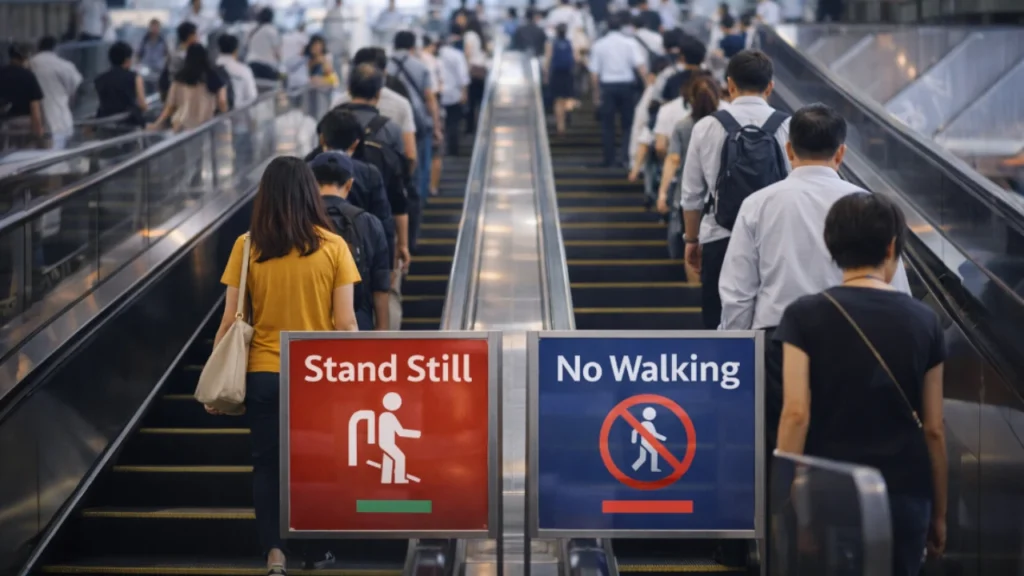
It might seem counterintuitive, but standing still on both sides of an escalator can improve overall flow — especially in crowded places:
- More people can fit on each step.
- Less congestion at the bottom and top entry points.
- Reduced queueing time in peak traffic.
Transport trials in London showed that when everyone stood — rather than walking on one side — escalators could carry up to 30% more people during busy times.
This doesn’t necessarily save every individual time, but it can speed up the overall crowd movement, which benefits users collectively.
4. Walking Adds Wear and Tear
Escalators aren’t staircases — they’re mechanical systems. Walking on them repeatedly can:
- create uneven pressure on the steps.
- add stress to internal mechanisms.
- increase maintenance needs and wear.
Manufacturers caution that excessive walking or uneven loading can accelerate machine breakdowns.
But What About People Who Say You Should Walk?
Many everyday users — especially in busy cities — argue that walking on escalators should be normal. On forums like Reddit and Quora, people say:
- Walking halves travel time compared to standing.
- Standing still blocks others from passing quickly.
- Escalators are just moving stairs, so walking makes sense.
These points reflect social norms and impatience, especially where people are in a hurry. But these opinions often clash with safety guidance from engineers and transit authorities.
So What’s the Best Approach?
✔ For Individual Safety
- Stand still when the escalator is busy.
- Hold the handrail
- Face forward
- Keep feet centered on the step.
✔ For Crowd Efficiency
- Standing on both sides early in peak periods can reduce delays.
❌ When Not to Walk
- On crowded escalators
- If you’re carrying large items or childcare equipment
- When elderly or less confident in balance are present
This approach aligns with increasing recommendations from escalator designers and safety experts around the world.
Final Takeaway
Walking on an escalator feels natural and sometimes seems faster — but when safety, crowd flow, and mechanical design are considered together, standing still is often the better choice for everyone involved. It may take a bit more patience, but the small personal delay can reduce falls, improve how escalators work for all users, and help keep crowded spaces moving more efficiently.

