
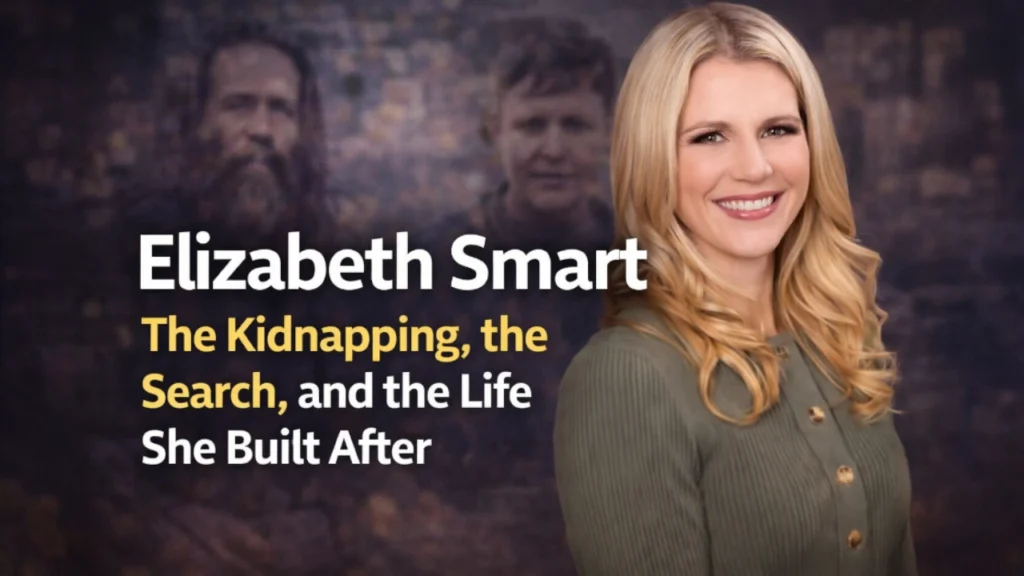
Elizabeth Smart’s name is one many people recognize instantly — but often only in fragments. A kidnapping headline. A rescue update. A court verdict years later.
What’s sometimes missed is the full arc of her story: how long she was missing, who kidnapped her, what happened afterward, and where she is now — not as a victim frozen in time, but as a survivor who rebuilt her life in public view.
The Night Elizabeth Smart Was Kidnapped
In June 2002, Elizabeth Smart was just 14 years old when she was abducted from her bedroom in Salt Lake City. The crime happened while her family slept, turning an ordinary home into the center of a nationwide search that would last months.
The question quickly on everyone’s mind was simple and terrifying: Who kidnapped Elizabeth Smart?
Investigators eventually identified the kidnappers as Brian David Mitchell and Wanda Barzee, a couple living on the margins of society, driven by extremist beliefs and paranoia.
How Long Was Elizabeth Smart Missing?
Elizabeth Smart was missing for nine months, a length of time that deeply shaped public perception of the case. During that period, she was taken across multiple locations and lived under constant coercion and fear.
The length of her captivity raised difficult questions later — not only about search efforts, but about how society understands control, trauma, and survival in abduction cases.
The Moment She Was Found
Elizabeth Smart was recovered alive in March 2003 after a chance encounter with police officers who noticed suspicious behavior from Mitchell and Barzee. Her survival was widely described as miraculous — but the road ahead was far from simple.
Her rescue marked the end of one chapter and the start of another: public scrutiny, legal proceedings, and long-term recovery.
Elizabeth Smart’s Story, Step by Step
These are the key moments that shaped one of the most closely followed kidnapping cases in the U.S.
What Happened to Elizabeth Smart’s Kidnappers?
The question “where are Elizabeth Smart’s kidnappers now?” continues to trend, largely due to renewed media attention and documentaries.
- Brian David Mitchell was eventually convicted and sentenced to life in prison without parole after years of legal delays related to mental competency.
- Wanda Barzee served a prison sentence, was released, and later returned to custody after a parole violation, before being released again under supervision.
The drawn-out legal process became an additional burden for Elizabeth Smart and her family, keeping the case in public conversation for decades.
Elizabeth Smart’s Family and the Role of Advocacy
Throughout the ordeal, Elizabeth Smart’s parents — including her mother, Lois Smart — became strong advocates for their daughter and for missing children nationwide.
Rather than retreat from the public eye, the family used media attention to highlight gaps in how abductions are reported and investigated. That advocacy would later become central to Elizabeth Smart’s adult life.
Elizabeth Smart Today: Where Is She Now?
For many years, people searched for updates using terms like “Elizabeth Smart, where is she now?” or “Elizabeth Smart documentary Netflix.”
Today, Elizabeth Smart is an author, activist, and public speaker focused on survivor advocacy. She has worked with national organizations, testified before lawmakers, and spoken openly about the realities of trauma — especially pushing back against outdated ideas about victim behavior.
She has also participated in and advised on documentaries and interviews, helping shape how her story is told, including through major streaming platforms and long-form journalism.
Why Elizabeth Smart’s Story Still Resonates
More than twenty years later, Elizabeth Smart’s case still draws attention — not because of shock value, but because it changed how people understand kidnapping survival.
Her story challenged myths:
- That survival requires constant physical resistance.
- That victims can simply “run away.”
- That recovery is quick once someone is found.
Instead, her life has shown that survival is complex, and healing is not linear.
The Bigger Impact
Elizabeth Smart’s work has influenced how law enforcement, media, and the public talk about missing children. She has redirected attention away from voyeurism and toward understanding — emphasizing responsibility on perpetrators, not survivors.
That shift may be her most lasting legacy.
Final Thoughts
Elizabeth Smart’s life cannot be reduced to the months she was kidnapped — even though those months changed her forever.
What followed matters just as much: her voice, her advocacy, and the impact she’s had on how the world views trauma and survival.
And that’s why, even years later, people are still searching her name — not just to remember what happened, but to understand what came after.