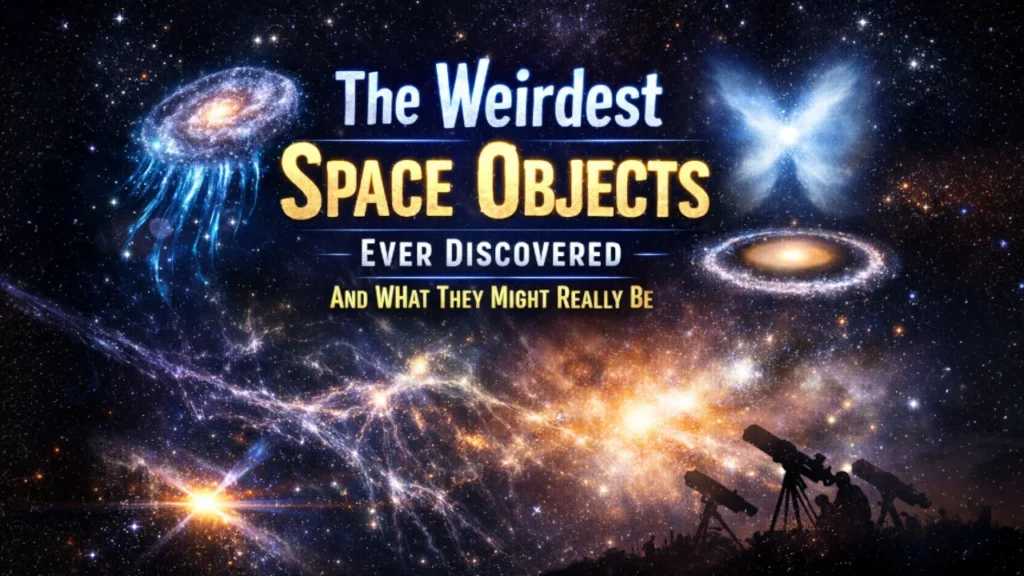
Space has a talent for humbling us.
Just when we think we’ve got the universe figured out — neat laws, tidy equations, clean categories — it throws something at us that looks alive, broken, or downright impossible. Objects that don’t behave. Shapes that shouldn’t exist. Signals with no clear source.
This isn’t sci-fi.
These are real things astronomers have spotted — and they’re still arguing about what many of them actually are.
Let’s take a tour of the strangest cosmic oddities ever discovered — and the unsettling (and fascinating) ideas scientists think might explain them.
1. Jellyfish Galaxies: When Galaxies Grow Tentacles
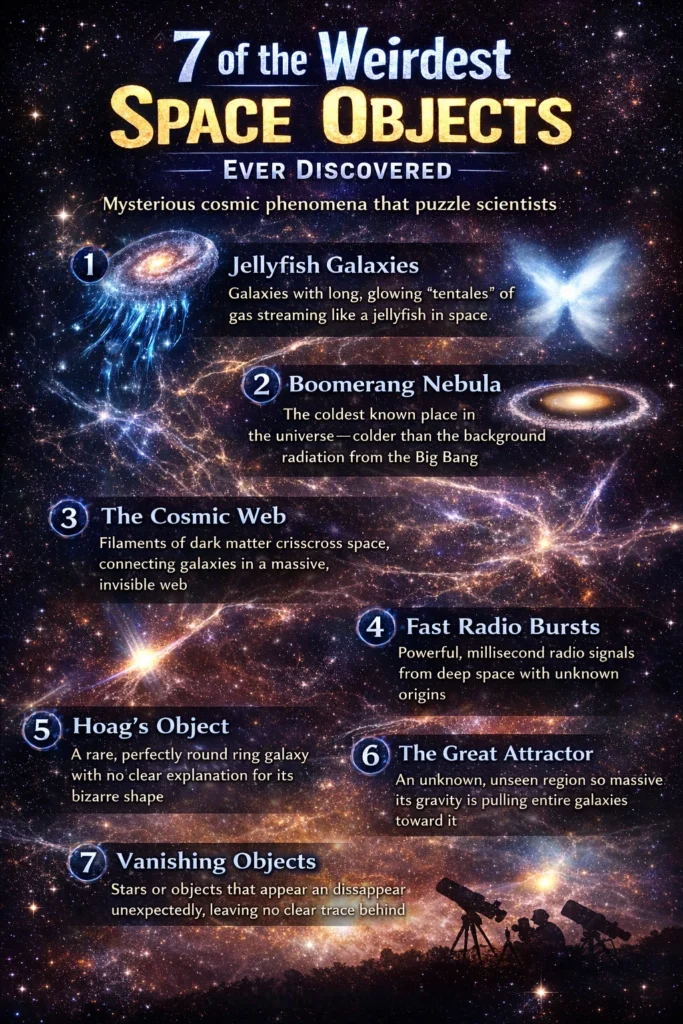
Picture a galaxy drifting through space… with glowing tendrils streaming behind it like a cosmic jellyfish.
That’s not poetic language. That’s literally what they look like.
What’s weird about them
- Massive “tentacles” of gas stretch thousands of light-years
- Star formation happens inside these trails.
- They appear torn, stretched, and wounded.
What they might really be
Scientists believe these galaxies are being violently stripped as they fall through dense galaxy clusters. Hot gas slams into them, ripping material out — like air resistance tearing flags apart at absurd speeds.
In other words:
Space itself is ripping these galaxies open.
2. The Boomerang Nebula: Colder Than Space Should Allow
Space is cold — about –270°C on average.
But this object? It’s colder.
The Boomerang Nebula is so cold it outfreezes every other known natural region in the universe.
Why that’s unsettling
- It breaks assumptions about cosmic temperature limits.
- Remarkably, the Boomerang Nebula appears colder than the ancient background radiation that still fills the universe after the Big Bang.
- It’s rapidly expanding at shocking speeds.
Possible explanation
A dying star ejected its outer layers so violently that the gas expanded faster than it could absorb heat, cooling it below anything else we’ve ever found.
It’s cosmic frostbite on a scale we didn’t know was possible.
3. The Cosmic Web: Invisible Skeleton of the Universe
Galaxies aren’t scattered randomly.
They’re arranged in vast filaments — long, faint threads of matter stretching across hundreds of millions of light-years, intersecting like an impossible spiderweb.
And most of it is invisible.
Why does this mess with our heads
- The filaments are made mostly of dark matter.
- We can’t see them directly.
- Yet galaxies move as if something massive is pulling them into place.
What it might really be
This may be the universe’s underlying structure — a kind of cosmic scaffolding formed shortly after the Big Bang.
We’re not seeing space.
We’re seeing the bones beneath reality.
4. Fast Radio Bursts: Signals That Refuse to Explain Themselves
For a few milliseconds, radio telescopes light up.
Then — silence.
Fast Radio Bursts (FRBs) are among the biggest mysteries in astronomy.
What makes them creepy
- Their energy release is far more than the Sun emits in days.
- They come from other galaxies.
- Some repeat; others don’t
- No two are fully alike.
Leading theories
- Neutron stars smashing together
- Magnetars cracking under extreme forces
- Exotic stellar remnants behaving badly.
And yes — scientists have considered alien technology. Not as a conclusion, but because some bursts defy simple explanations.
When your data is weird enough, nothing gets ruled out early.
5. Hoag’s Object: A Galaxy That Shouldn’t Exist
Imagine a perfect ring of stars…
No arms.
No central bar.
No obvious cause.
Just a glowing circle floating alone in space.
Why astronomers hate (and love) it
- It doesn’t match standard galaxy formation models.
- There’s no nearby object to explain the shape.
- Even simulations struggle to recreate it.
Current thinking
It may be a rare outcome of extremely calm cosmic conditions — or a remnant of a long-gone interaction that left no trace.
Or it could be something we that we have no idea about yet.
Space has a habit of waiting.
6. The Great Attractor: Something Is Pulling Everything
Entire galaxies — including our own region of the universe — are moving toward something.
We can’t see it directly.
But the pull is undeniable.
What makes it disturbing
- There are thousands of galaxies moving or drifting in the same direction.
- Hidden behind thick cosmic dust
- Incredibly massive
Likely explanation
A concentration of galaxies and dark matter so dense that its gravity reshapes local cosmic motion.
Less officially:
There’s something out there tugging on the universe — and we’re still squinting through the fog trying to see it.
7. Objects That Appear… Then Vanish
Some cosmic objects show up once.
Then never again.
Astronomers have recorded
- Stars that dim dramatically and stay that way
- Bright flashes with no repeat
- Entire objects that vanish between observations
Possible reasons
- Dust clouds are blocking the light.
- Exotic stellar deaths
- Observational gaps
Or — and this is the uncomfortable part — events we don’t yet have names for.
Discovery doesn’t always arrive with an explanation.
Why These Objects Matter More Than You Think
These aren’t just cosmic curiosities.
They’re stress tests for our understanding of reality.
Every strange shape, missing explanation, or impossible temperature forces science to:
- Rewrite models
- Update assumptions
- Admit uncertainty
And that’s how progress happens.
The universe doesn’t owe us clarity.
It offers puzzles — and waits to see who keeps asking questions.
The Quiet Truth About Space
The more we observe, the stranger things get.
Not because the universe is broken.
But because our understanding is still small.
And maybe that’s the most beautiful part.
If the cosmos can still surprise us — twist into jellyfish, freeze past limits, whisper in unexplained signals — then discovery isn’t over.
It’s just getting started.
💬 What do you find most unsettling — disappearing objects, invisible cosmic forces, or signals we can’t explain?
Share this with someone who loves weird science, and keep the curiosity moving.