
For more than half a century, humans have stayed close to home in space.
Low Earth orbit. Space stations. Routine missions.
And now—quietly, almost unreal—four people are preparing to leave it all behind.
No live rescue.
No quick return.
No safety net circling Earth every 90 minutes.
When Artemis II launches, it won’t just test rockets and spacecraft. It will test something deeper and more fragile: the human mind.
Because going back to the Moon isn’t just a technical challenge.
It’s a psychological one.
The First Ones in Decades — And That Weight Never Leaves
The Artemis II crew knows something few humans ever have.
They will become the first people since Apollo 17 (1972) to:
- Leave Earth’s protective magnetic bubble.
- Watch Earth shrink into a blue dot.
- Experience deep space isolation again.
This isn’t a landing mission. There’s no dramatic moonwalk.
Instead, it’s something quieter—and in many ways, harder.
Ten days inside a spacecraft.
No resupply.
No hiding from yourself.
Astronauts describe this as “the long silence.”
One astronaut once said:
“Low Earth orbit feels busy. Deep space feels… personal.”
Training the Mind as Much as the Body
We envision astronaut training as physical, involving centrifuges, spacewalk drills, and endurance tests.
But Artemis II preparation goes far beyond muscle and reflexes.
Psychological Conditioning Comes First
NASA psychologists work closely with the crew on:
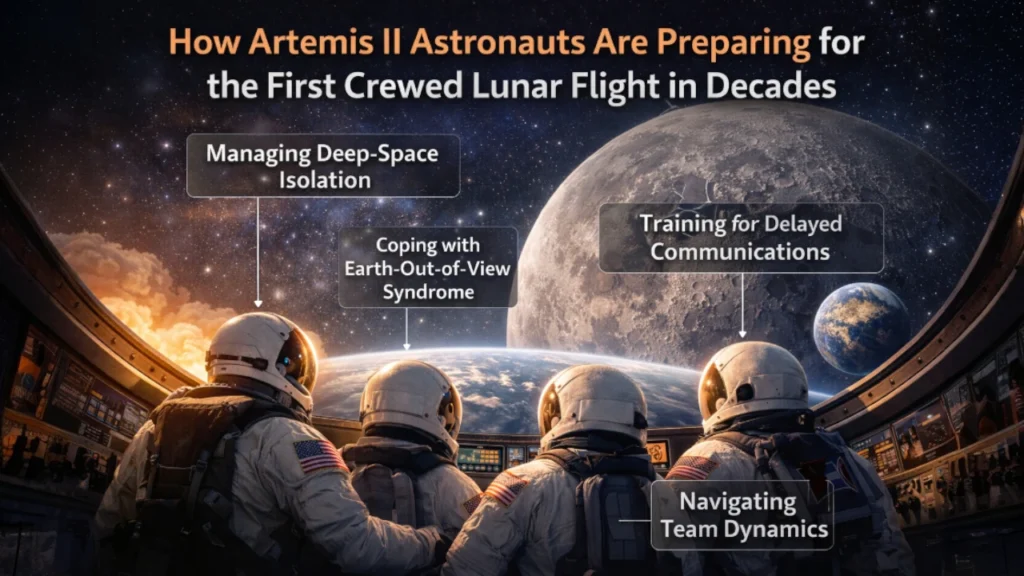
- Emotional regulation under isolation
- Conflict de-escalation in confined spaces
- Decision-making when there is no immediate help
- Managing fear without suppressing it
Unlike the ISS, this crew can’t call Mission Control and expect instant reassurance.
There’s a delay.
Sometimes minutes.
They’re training to be calm in the absence of answers.
The Unspoken Fear: Seeing Earth From the Outside
Astronauts rarely talk about this before launch, but many describe it afterward.
Looking back at Earth from deep space can be a disconcerting experience.
Not inspiring.
Not poetic.
Disorienting.
Earth looks small. Fragile. Silent.
Some astronauts’ experience:
- Sudden waves of homesickness
- Emotional detachment
- A strange grief for everything familiar
NASA calls this “Earth-out-of-view syndrome.”
And Artemis II will be the first crew in decades to confront it directly.
Inside the Crew Dynamic: No Escaping Each Other
Four people.
One capsule.
The Orion spacecraft is powerful, advanced, and tight.
No private rooms.
No stepping outside for air.
No way to walk off frustration.
So NASA studies group psychology intensely.
The crew practices:
- Living together during simulated communication blackouts
- Making joint decisions while tired
- Navigating disagreements without hierarchy
Commanders aren’t dictators in deep space.
They are facilitators.
Because tension in a capsule isn’t uncomfortable—it’s dangerous.
Fear Isn’t Removed. It’s Managed.
Contrary to popular belief, astronauts aren’t fearless.
They feel fear very clearly.
They just relate to it differently.
During Artemis II prep:
- Crew members openly discuss worst-case scenarios.
- They rehearse disaster conversations on purpose.
- They learn how to acknowledge fear without letting it dominate decisions.
One training mantra stands out:
“Fear is information, not an instruction.”
That mindset can save lives.
The Pressure of Representing Humanity
Every Artemis II astronaut carries a quiet burden.
They’re not just test pilots.
They’re symbols.
For:
- A new generation that’s never seen humans leave Earth orbit
- Future Moon landings
- Mars ambitions
If Artemis II fails, public confidence wavers.
If it succeeds, history moves forward.
That weight is real.
And it follows them into training, into sleep, into quiet moments.
Why This Mission Feels Different From Apollo
Apollo astronauts were explorers in a race.
Artemis astronauts are path-builders.
They know:
- Millions will watch every move.
- Social media will analyze every word.
- Their psychological strength matters as much as technical success.
The world has changed.
Expectations are heavier.
Silence is louder.
The Moment That Changes Everything
There’s a point in the mission timeline that trainers talk about quietly.
A moment when:
- Earth slips behind the spacecraft.
- Communication delay becomes noticeable.
- The crew realizes they are truly on their own
Veterans call it “the deep space click.”
That’s when the mission becomes real.
Not on launch day.
Not during the countdown.
But when Earth is no longer right there.
Why People Are So Drawn to Artemis II
Because it reminds us of something we’ve forgotten.
That progress isn’t just hardware.
It’s courage.
Emotional discipline.
Human vulnerability.
Artemis II isn’t just flying around the Moon.
It’s proving that humans are still willing to step into uncertainty—together.
Final Thought
When Artemis II lifts off, rockets will roar, and headlines will shout.
But the most important journey won’t be visible on any screen.
It will be happening inside the minds of four people, carrying humanity past the edge of what feels safe—once again.
And maybe that’s why this mission matters so much.
Would you trust yourself to leave Earth, knowing you can’t come back quickly?
If this story moved you, share it. Someone else might need the reminder that courage still exists. 🚀
FAQs:
1. What is Artemis II and why is it important?
Artemis II is NASA’s first crewed mission to travel beyond Earth orbit in more than 50 years. It will send astronauts around the Moon to test spacecraft systems, crew performance, and deep-space operations before future Moon landings and Mars missions.
2. Who are the astronauts flying on Artemis II?
Artemis II will carry a four-member crew consisting of experienced NASA astronauts and an international partner. They are trained test pilots, engineers, and mission specialists responsible for validating human deep-space flight systems.
3. Will Artemis II land on the Moon?
No. Artemis II is a lunar flyby mission, not a landing. The spacecraft will orbit the Moon and return to Earth, focusing on crew safety, navigation, and life-support systems.
4. How long will the Artemis II mission last?
The Artemis II mission is expected to last around 10 days, including launch, lunar orbit, and return to Earth.
5. Why is Artemis II more psychologically challenging than ISS missions?
Unlike International Space Station missions, Artemis II astronauts will leave Earth’s orbit, experience delayed communication with Mission Control, and face complete isolation without resupply or quick rescue options.
6. How far from Earth will Artemis II travel?
Artemis II will travel far beyond low Earth orbit, reaching distances of hundreds of thousands of kilometers, similar to Apollo missions but with modern spacecraft and systems.
7. What spacecraft is Artemis II using?
The crew will fly aboard NASA’s Orion spacecraft, launched on the Space Launch System (SLS) rocket. Orion is designed specifically for deep-space human missions.
8. How does Artemis II prepare humans for Mars missions?
Artemis II tests long-duration isolation, radiation exposure, delayed communication, and crew decision-making — all critical conditions humans will face during future Mars missions.