

The Surprising Truth
Here’s something science has quietly confirmed over a research for the past decade:
Some people really do get sick less often — and it’s not just luck, lifestyle, or immunity habits.
Their bodies respond differently at a genetic level.
Not because they’re “superhuman.”
Not because they never encounter germs.
But because one specific part of their genetic code changes how their immune system reacts in the first few hours of exposure.
And that early response matters more than most people realize.
First, a Reality Check
Let’s be clear.
There is no gene that makes someone immune to all diseases.
No human is invincible.
But research does show that certain gene variants help the body detect, respond to, or block infections faster and more efficiently — sometimes before symptoms even appear.
That difference can mean:
- A mild response instead of a full illness
- Faster recovery
- Or no noticeable sickness at all
What This “Single Gene” Actually Does
The gene scientists focus on isn’t about killing viruses directly.
It controls how the immune system recognizes threats.
In simple terms:
- Your immune system has sensors.
- Those sensors decide how urgently to react.
- Some people’s sensors fire faster and cleaner.
When this gene variant is present:
- Inflammation is better regulated.
- Immune cells communicate more clearly.
- The body avoids overreacting or underreacting.
The result?
Fewer symptoms. Less damage. Faster resolution.
This idea of balance rather than brute force also shows up in longevity research, where scientists are exploring whether slowing certain ageing processes can reduce long-term inflammation and cellular damage — though not without limits.
Why Timing Matters More Than Strength
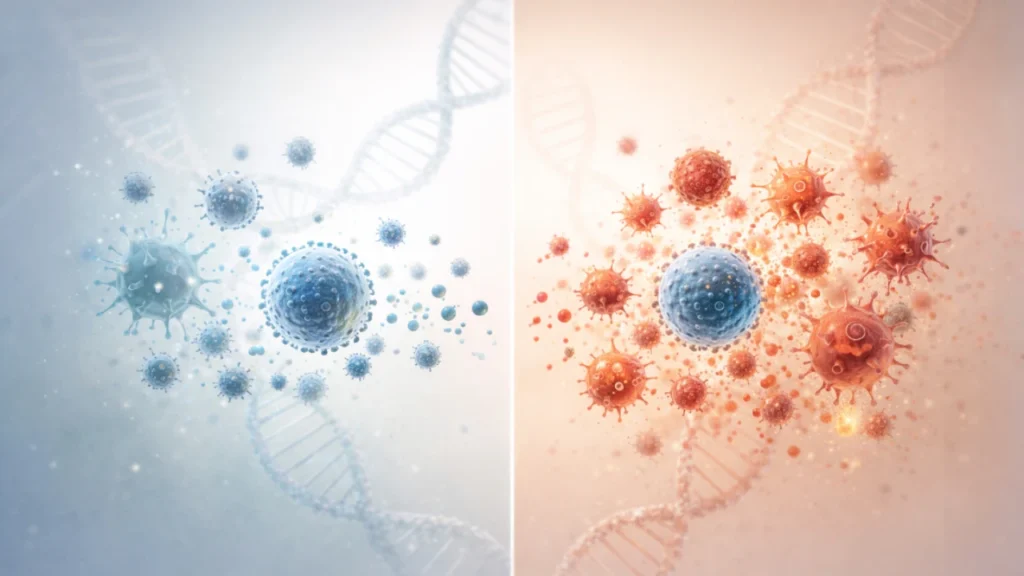
Most people think immunity is about power.
It isn’t.
It’s about timing.
If your immune system:
- Reacts too slowly → the infection spreads
- Reacts too aggressively → you feel sicker than necessary.
People with certain gene variants hit a sweet spot.
They respond early — without chaos.
That’s often the difference between:
- “I was sick for a week.”
- “I felt sick for a day, and then it went away.”
What Scientists Have Actually Observed
Studies on genetic immunity have found that:
- Some people resist common viruses more effectively.
- Others rarely develop symptoms despite exposure.
- Certain infections fail to establish themselves at all.
This has been observed with:
- Respiratory viruses
- Chronic infections
- Inflammatory responses
The key pattern: the immune system’s first response is more balanced.
This Is Where People Get It Wrong
A lot of people assume:
“Many believe not getting ill is equal to stronger immunity.”
That’s not always true.
In some cases:
- The immune system isn’t stronger.
- It’s more controlled.
Getting sick often isn’t about failing to fight germs — it’s about the body damaging itself while fighting them.
The gene doesn’t stop exposure.
It changes the reaction.
Why Everyone Doesn’t Have This Advantage
Genes vary for a reason.
What helps in one environment might not help in another:
- Some immune traits protect against infections.
- Others protect against allergies or autoimmune issues.
Evolution doesn’t optimize for perfection.
It optimizes for survival under different conditions.
That’s why immunity looks different across populations.
Can This Be Used for Treatment?
This is where things get interesting — and cautious.
Scientists are studying whether:
- Immune responses can be tuned, not boosted.
- Overreaction can be reduced safely.
- Early detection pathways can be improved.
But this isn’t a pill situation.
It’s about understanding balance, not creating “perfect immunity.”
What This Means for Everyday People
You can’t change your genes.
But this research explains why:
- Two people exposed to the same illness feel completely different.
- Some recover fast, while others struggle.
- Lifestyle alone doesn’t explain everything.
Health isn’t just behavior.
It’s biology interacting with the environment.
The Bigger Picture
This research doesn’t prove some people are “immune.”
It proves something more subtle — and more important:
How the body responds matters more than the threat itself.
That idea is shaping how scientists think about:
- Inflammation
- Chronic illness
- Future treatments
Final Thought
The goal of medicine isn’t to eliminate every germ.
It’s to help the body respond without hurting itself.
Understanding why some people rarely get sick shows us that balance beats brute force.
This changes how we think about immunity, illness, and what “being healthy” really means.