The Surprising Truth
Here’s a fact that sounds unreal, but isn’t:
The human body begins to change within days of leaving Earth — and some of those changes never fully reverse.
Not after 100 years.
Not after decades.
After days.
So what really happens if a human body stays in space for a century?
Let’s separate what science knows from what people assume.
First, a Reality Check
No human has spent 100 years in space.
Not even close.
But we do have:
- Astronauts who stayed in space for months and years
- Twin studies comparing space vs Earth bodies
- Decades of medical data from the International Space Station
From that, scientists can identify patterns — and patterns are how long-term effects are understood.
This isn’t speculation.
It’s an extrapolation from real evidence.
What Space Immediately Does to the Body
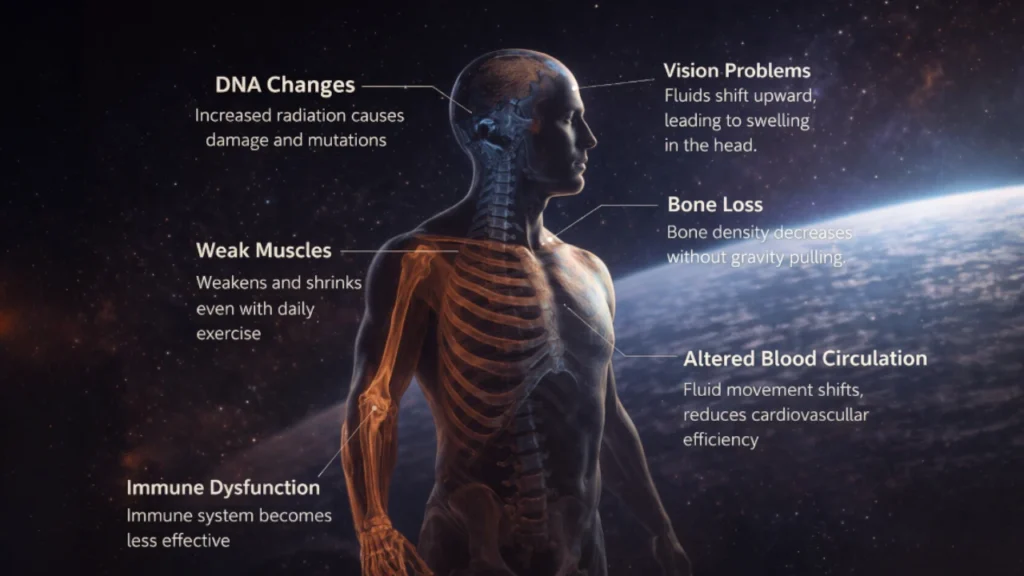
1. Bones Start Losing Strength
On Earth, gravity constantly stresses your bones.
In space, that stress disappears.
Without it:
- Bones lose density
- Calcium leaks into the bloodstream
- Fracture risk increases
Even with daily exercise, astronauts lose bone mass at a faster rate than elderly people on Earth.
Now multiply that over decades.
2. Muscles Shrink — Even If You Work Out
Muscles exist to fight gravity.
Take gravity away:
- Muscles weaken
- Endurance drops
- Strength declines
Astronauts train hours a day just to slow this down — not stop it.
Over 100 years, muscles wouldn’t just weaken.
They’d fundamentally change how they function.
3. The Heart Gets Smaller
This one surprises people.
In space:
- The heart doesn’t work as hard.
- Blood moves more easily.
- The heart muscle gradually shrinks.
A smaller heart struggles when gravity returns.
After extremely long-term exposure, the heart may never adapt back fully.
How the Body Changes Over Time
Blood Doesn’t Flow as It Should
On Earth, blood pools slightly in the legs.
In space, it shifts upward.
This causes:
- Puffy faces
- Pressure in the head
- Vision problems over time
Long-term astronauts already report lasting eyesight changes.
Over decades, the nervous system may permanently adjust to a gravity-free blood flow — making Earth-like gravity overwhelming.
The Immune System Becomes Confused
Space alters immune responses.
Studies show:
- Reactivation of dormant viruses
- Reduced immune efficiency
- Higher inflammation markers
Over long periods, this could mean:
- Slower healing
- Higher infection risk
- Chronic immune imbalance
Not dramatic.
Just quietly dangerous.
DNA Actually Changes
Radiation in space is unavoidable.
Unlike Earth, there’s little protection from:
- Cosmic rays
- Solar radiation
What we’ve observed:
- DNA damage increases
- Repair mechanisms struggle
- Cellular mutations rise
Astronaut twin studies confirm this:
space doesn’t just affect the body — it affects cells at a genetic level.
Aging in Space Is Different From Aging on Earth
This is important.
Space doesn’t simply “speed up aging.”
It changes the rules of aging.
Instead of wrinkles and stiffness, aging in space looks like:
- Fragile bones
- Altered circulation
- Weakened muscles
- Stressed DNA
- Altered brain signals
You might look fine.
But function very differently.
Research into space travel has also reshaped how scientists think about aging on Earth — including recent studies that suggest aging itself may be slowed, though not without serious limits.
Could the Body Survive 100 Years in Space?
Survive?
Maybe — with extreme medical support.
Function normally?
No.
After that long:
- Returning to Earth, gravity might be fatal.
- Standing upright could be impossible.
- Bones and muscles may not handle weight.
- The cardiovascular system may fail.
The body would no longer be optimized for Earth.
It would be adapted — imperfectly — to space.
This Is Where People Get It Wrong
Most people think the biggest problem is distance.
It isn’t.
The real issue is the environment.
The human body evolved for:
- Gravity
- A magnetic field
- Radiation shielding
Remove those, and the body doesn’t break instantly.
It gradually rewrites itself.
Not intelligently.
Just biologically.
Why This Matters Beyond Space Travel
This isn’t just about astronauts.
Space research teaches us:
- How bones weaken
- How muscles degrade
- How aging accelerates
- How isolation affects the brain
- How the body reacts to extreme environments
These insights help:
- Elderly care
- Muscle disease research
- Bone loss treatments
- Long-term bed rest recovery
Space is the most extreme medical lab humanity has.
The Real Takeaway
Human biology is remarkably adaptable, but it has clear boundaries.
It adapts.
But adaptation comes with trade-offs.
A century in space wouldn’t make humans superior.
It would make them different.
And not always in ways we’d survive back on Earth.