
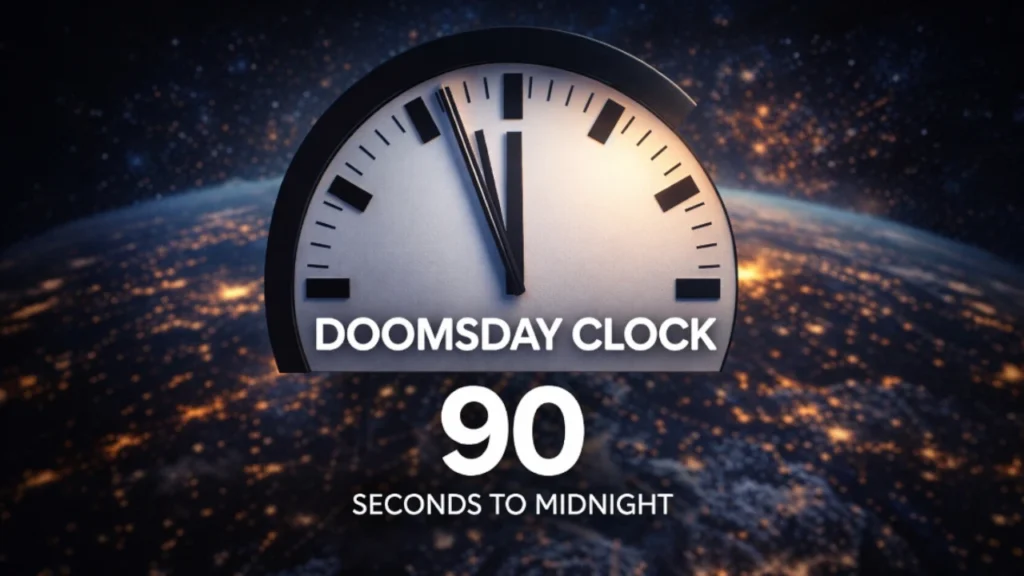
Each year, the Doomsday Clock sparks a familiar mix of curiosity and unease. Headlines mention seconds, warnings, and global risk — but what does the clock actually measure, and what does its 2026 setting really tell us?
The answer is more nuanced than panic — and more sobering than a simple metaphor.
To understand this annual ritual, it helps to know what the Doomsday Clock actually is.
The Doomsday Clock is a symbolic clock created in 1947 by scientists associated with the Bulletin of the Atomic Scientists. It represents how close humanity, in its expert judgment, is to a man-made global catastrophe.
Midnight does not mean an exact prediction of disaster.
It is a communication tool — meant to reflect relative risk, not a countdown.
Since its creation during the nuclear age, the clock has expanded to account for:
- Nuclear weapons threats
- Climate change
- Emerging technologies
- Global political instability
0df1b215-3866-4865-9f7e-80a72da…
With that history in mind, where is the Doomsday Clock set now, in 2026?
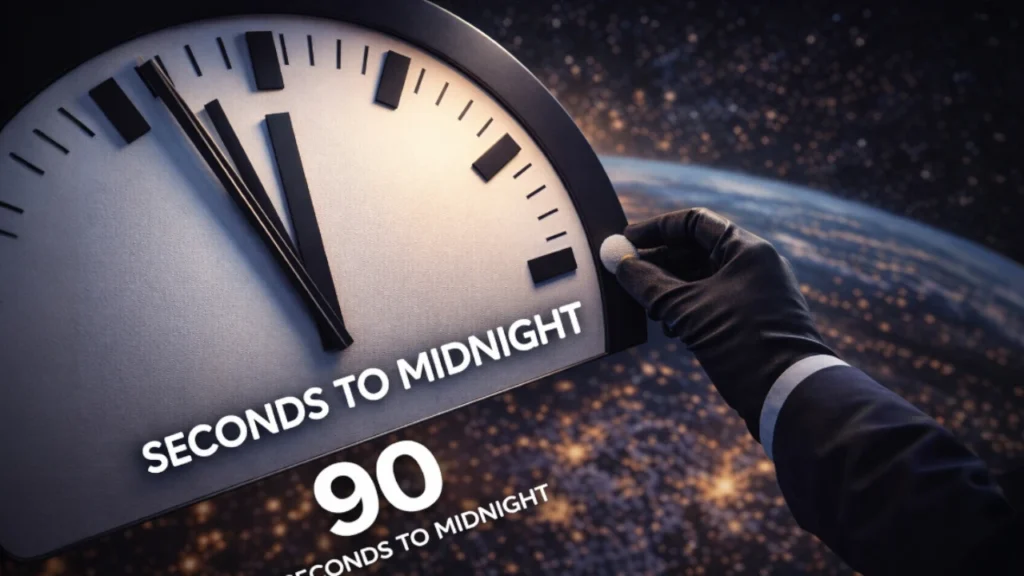
In 2026, the Doomsday Clock remains at 90 seconds to midnight, the closest it has ever been to midnight.
This decision reflects concerns that global risks have not meaningfully improved over the past year — even if they haven’t worsened enough to move the clock closer.
According to experts involved in setting the clock, holding the time steady is itself a warning: persistent danger without progress.
0df1b215-3866-4865-9f7e-80a72da…
Why 90 Seconds Still Matters
It’s easy to think that if the clock hasn’t moved, nothing has changed. But the scientists behind it argue the opposite.
Keeping the clock at 90 seconds signals that:
- Existing global risks remain unresolved.
- Geopolitical tensions are still high.
- Nuclear arms control remains fragile.
- Climate commitments are not translating fast enough into results.
In other words, stability at a dangerous point is not safety — it’s stagnation.
0df1b215-3866-4865-9f7e-80a72da…
What Risks Are Influencing the Clock Right Now?
Nuclear Threats
Tensions involving nuclear-armed states remain a core reason the clock is set so close to midnight. Arms reduction agreements are under strain, and modernization of nuclear arsenals continues.
Climate Change
Climate impacts are becoming more visible and more disruptive. Scientists emphasize that while awareness has grown, action remains inconsistent across governments.
Technology and Misinformation
Advances in artificial intelligence, cyber warfare, and misinformation are now considered destabilizing forces. These technologies can escalate conflict faster than traditional diplomacy can respond.
0df1b215-3866-4865-9f7e-80a72da…
Does the Doomsday Clock Mean We’re About to End?
No — and the scientists are careful to stress this.
The Doomsday Clock is not a prediction. It doesn’t claim a catastrophe will happen at a specific time. Instead, it asks a different question:
Are global leaders and societies reducing risk — or managing it poorly?
In 2026, the answer appears to be: not enough progress.
Why the Clock Is Also About Wellness
An interesting shift in recent coverage is how the Doomsday Clock intersects with public mental health. Constant exposure to crisis headlines can lead to fatigue, anxiety, or apathy.
Experts argue the clock’s purpose isn’t to induce fear, but to:
- Encourage informed awareness
- Promote civic engagement
- Push leaders toward cooperation rather than escalation.
When viewed this way, the clock is as much about human decision-making as it is about global systems.
0df1b215-3866-4865-9f7e-80a72da…
Has the Clock Ever Moved Back?
Yes — and that’s an important part of its history.
The clock has moved away from midnight during periods of:
- Nuclear arms reduction agreements
- Improved international cooperation
- Lower perceived global risk
This reinforces a key point: human action influences the clock.
Why the Doomsday Clock Still Gets Attention
Decades after it was introduced, the Doomsday Clock remains relevant because it distills complex global issues into a single, understandable symbol.
It doesn’t offer comfort.
But it offers clarity.
And in an era flooded with noise, that clarity still cuts through.
Final Thought
The Doomsday Clock 2026 doesn’t tell us what will happen. It tells us what could happen if risk continues to be ignored or normalized.
At 90 seconds to midnight, the message isn’t panic.
It’s a responsibility.

