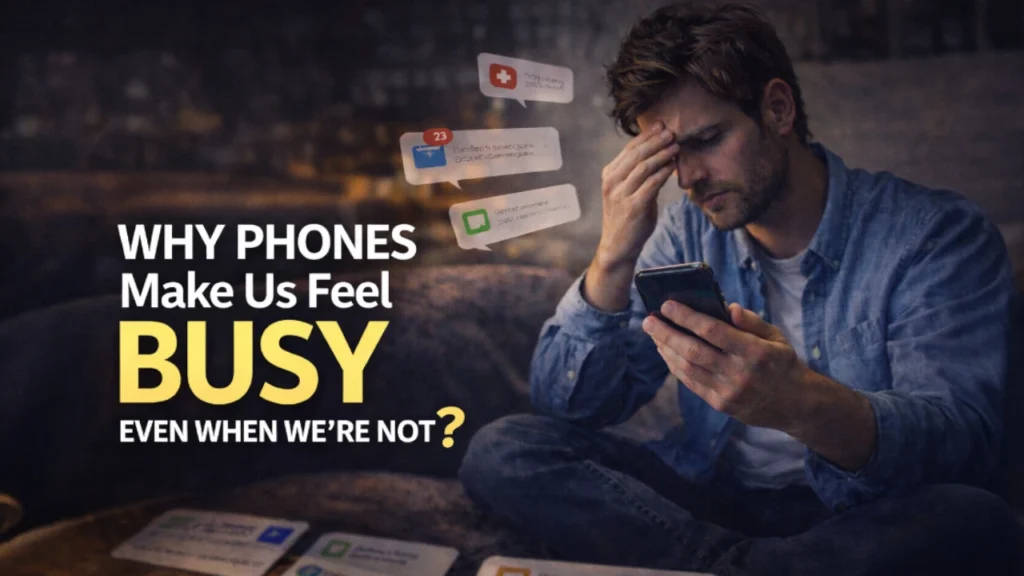
You didn’t do much today.
No big meetings.
No urgent deadlines.
No chaos.
And yet… You feel weirdly exhausted.
Your brain feels full.
Your attention feels stretched.
And by evening, you’re tired in a way that doesn’t quite make sense.
That feeling has a name — and your phone has a lot to do with it.
Busy Isn’t the Same as Doing
Here’s the strange part about modern “busy.”
You can feel overwhelmed without actually accomplishing much.
That’s because busyness today isn’t about physical effort.
It’s about mental fragmentation.
Every glance at your phone pulls your attention somewhere else — even if only for a second.
Those seconds add up.
Your Brain Wasn’t Built for Constant Switching
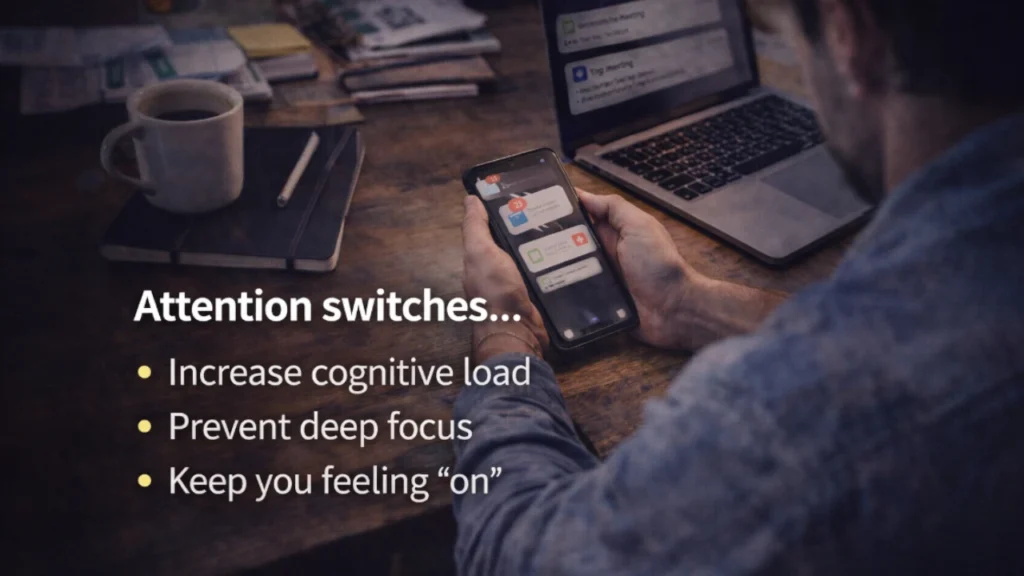
Each time you:
- Check a message
- Read a notification
- Glance at your lock screen.
- Open an app “just for a second.”
Your brain switches contexts.
Context switching has a cost.
Even if you return to what you were doing, your brain needs time to reorient.
That invisible effort is called cognitive load — and phones continually stack it.
Why It Feels Like You’re Always “On”
Phones don’t demand long attention anymore.
They demand frequent attention.
You’re not focused deeply — you’re constantly resetting.
Small interruptions don’t feel dramatic, but they create:
- Mental residue
- Shallow focus
- A lingering sense of unfinished tasks
By the end of the day, your brain feels like it’s been open too many tabs at once.
Notifications Aren’t the Only Culprit
Even when notifications are turned off, the phone still performs a subtle action.
It signals availability.
Your brain learns:
“I might need to respond at any moment.”
That anticipation alone consumes mental energy.
This connects directly to why notifications feel more stressful than helpful — not because they’re loud, but because they never fully let your brain rest.
The Illusion of Productivity
Scrolling feels light.
Checking feels harmless.
Responding feels quick.
But each micro-interaction:
- Splits attention
- Prevents mental recovery
- Creates a false sense of urgency
So you feel busy — even if nothing truly demands you.
This is why people finish days feeling drained yet oddly unsatisfied.
Why This Hits Harder on Mobile
Mobile devices make it worse because:
- They follow you everywhere.
- They compress information into bite-sized distractions.
- They normalize constant partial attention.
On a phone, there’s no clear start or end.
Everything feels like it’s happening in between lives.
That’s exhausting.
The Hidden Stress You Don’t Notice
This kind of stress doesn’t feel like panic.
It feels like:
- Low-grade tension
- Mental fog
- Difficulty starting things
- Irritability without a clear reason
Many people mistake this for burnout — when it’s actually attention fatigue.
This is why tech alerts are easier to ignore than ever — the brain quietly pushes back against overload.
Why We Still Blame Ourselves
Most people don’t blame the system.
They think:
“I just need better discipline.”
But the problem isn’t willpower.
It’s environment.
Phones are designed for engagement, not mental pacing.
Feeling busy isn’t a personal failure.
It’s a predictable outcome.
What Actually Helps (Without Going Extreme)
You don’t need to quit your phone.
Small shifts make a difference:
- Fewer checks, not zero
- Clear blocks of focus
- Less switching, more finishing
- Let silence exist without filling it.
The goal isn’t productivity.
It’s mental continuity.
The Real Takeaway
Phones don’t make us busy because they give us too much to do.
They make us busy because they never let attention settle.
And when attention can’t settle, rest doesn’t feel like rest.
That’s why you feel tired — even on quiet days.