
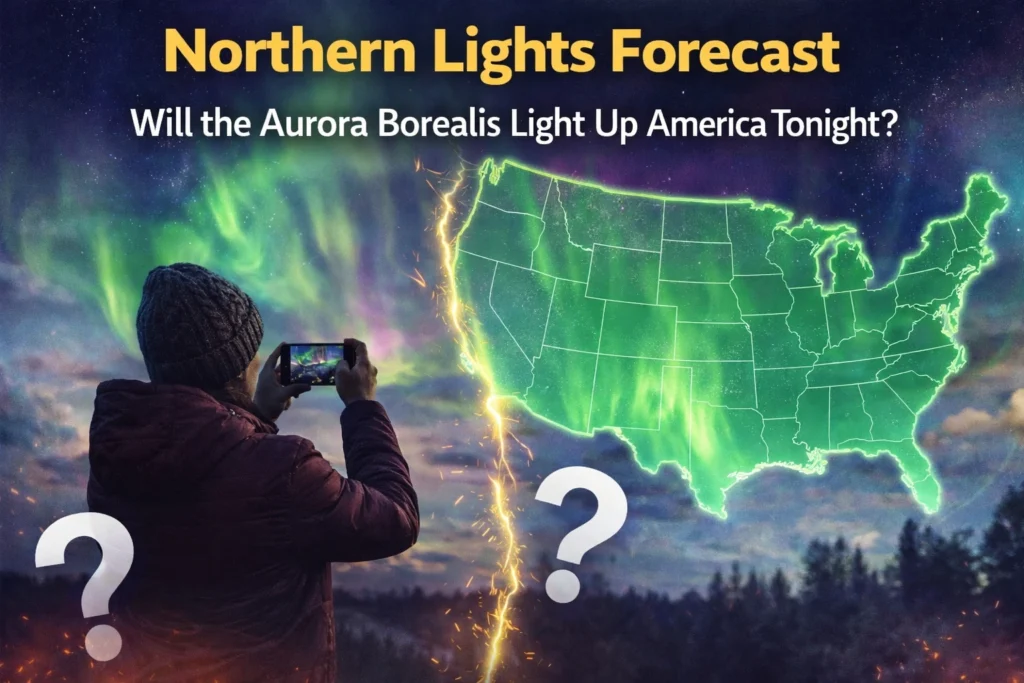
Look up — there’s a good chance the sky could come alive with shimmering greens and reds tonight! A fast stream of solar wind is buffeting Earth’s magnetic field, and that means Northern Lights (Aurora Borealis) may be visible across much of the northern United States tonight into early tomorrow morning.
This blog breaks down:
- What’s causing this aurora activity
- States where you could see the lights
- Best times and tips to watch
- How to boost your viewing odds
What’s Behind the Northern Lights Tonight
Auroras happen when charged particles from the sun interact with Earth’s magnetic field and upper atmosphere. Those particles excite oxygen and nitrogen atoms, which then release light — that’s the colorful glow we call the Northern Lights.
Right now, Earth is being hit by a high-speed solar wind stream from a coronal hole on the sun’s surface — a region where solar material escapes more easily. When this stream reaches Earth, it disturbs the magnetic field and triggers geomagnetic storms. These storms are measured by NOAA’s Kp index and G-levels:
- G1 (Minor) geomagnetic activity may be enough for aurora displays in northern states.
- If activity increases briefly, the Northern Lights may become visible farther south.
NOAA’s Space Weather Prediction Center forecasts minor to moderate geomagnetic storm conditions tonight (Jan. 16-17) — perfect for a potential aurora show.
📍 Where You Might See the Northern Lights
According to the latest NOAA aurora forecast maps, these 15 states fall fully or partially within the aurora viewing zone tonight:
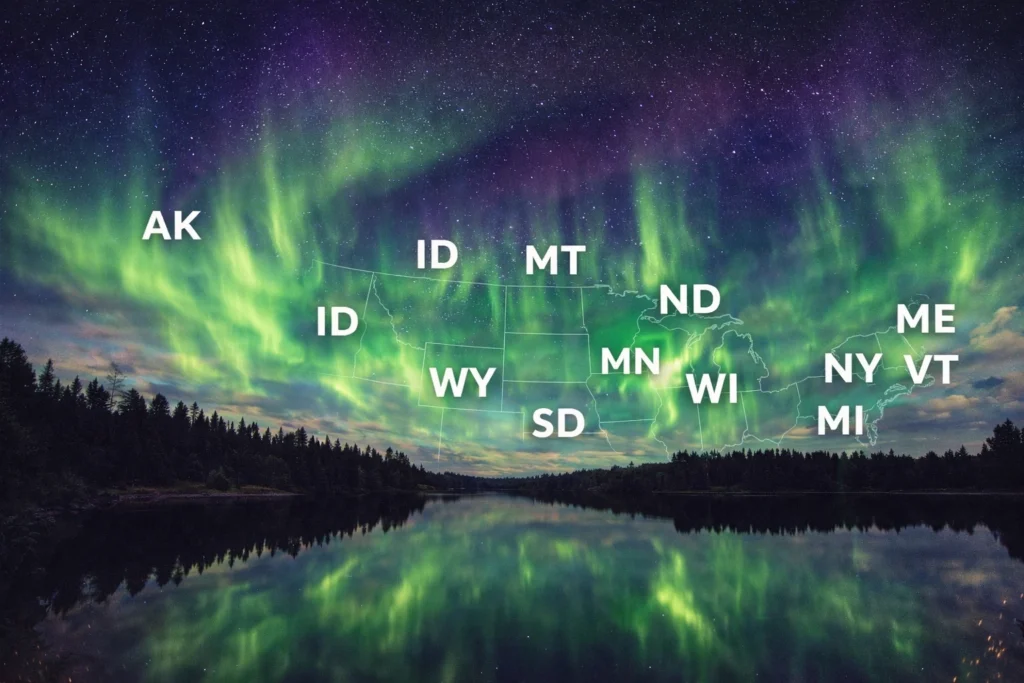
- Alaska
- North Dakota
- Minnesota
- Montana
- Wisconsin
- Michigan
- South Dakota
- Idaho
- Maine
- Vermont
- New Hampshire
- Washington
- Iowa
- Wyoming
- New York
If the geomagnetic activity strengthens, displays could reach even farther south — but it’s unpredictable, so staying updated with real-time aurora alerts is key.
Best Time to Watch
Auroras aren’t usually visible until after sunset, when the sky is fully dark. For tonight (Jan. 16-17):
Best viewing window:
Around 1 a.m. to 7 a.m. EST (06:00 – 12:00 UTC) — this is when NOAA predicts geomagnetic activity will be strongest.
Try to be outside before midnight so your eyes can adapt to the darkness. The darker your location, the better your odds.
Tips to Increase Your Odds of Seeing the Northern Lights
Find the Right Spot
- Head to a dark, open location away from city glow.
- Look northward toward the horizon — the auroras often appear low at first.
Use Technology
- Use real-time aurora forecast apps or NOAA alerts to track activity.
- Check live sky conditions; a sudden increase in geomagnetic intensity can make all the difference.
Photography Tips
- Many smartphones now have Night Mode — it can capture faint aurora glows ordinary eyes might miss.
- A DSLR/mirrorless camera on a tripod with long exposures will yield the best results.
Quick Science Explainer
When fast solar wind hits Earth’s magnetosphere:
- The magnetic field wiggles.
- Electrons and protons dive into the upper atmosphere.
- Colliding with gases produces light — typically green, sometimes red or purple.
- The further south the Kp index reaches, the wider the viewing zone becomes.
Right now, solar activity is still elevated due to the ongoing solar maximum — a period of heightened activity in the sun’s 11-year cycle — which means auroras may stay visible in the years around 2026 more often than usual.
Final Tips Before You Step Outside
- Dress warmly: January nights can be freezing in northern states.
- Bring snacks and patience: The aurora can surprise you — or take time to appear.
- Check cloud cover: Even strong auroras can be hidden by overcast skies.
Whether you’re a seasoned skywatcher or a first-time stargazer, tonight might be your chance to catch nature’s most dazzling light show.
Quick State Checklist
Here are the 15 states most likely to see auroras tonight:
Alaska • Michigan • Minnesota • Washington • Wisconsin • North Dakota • South Dakota • Idaho • Maine • Vermont • New Hampshire • Montana • Iowa • Wyoming • New York